
Alligator Cracking Repair: What Works on Commercial Asphalt
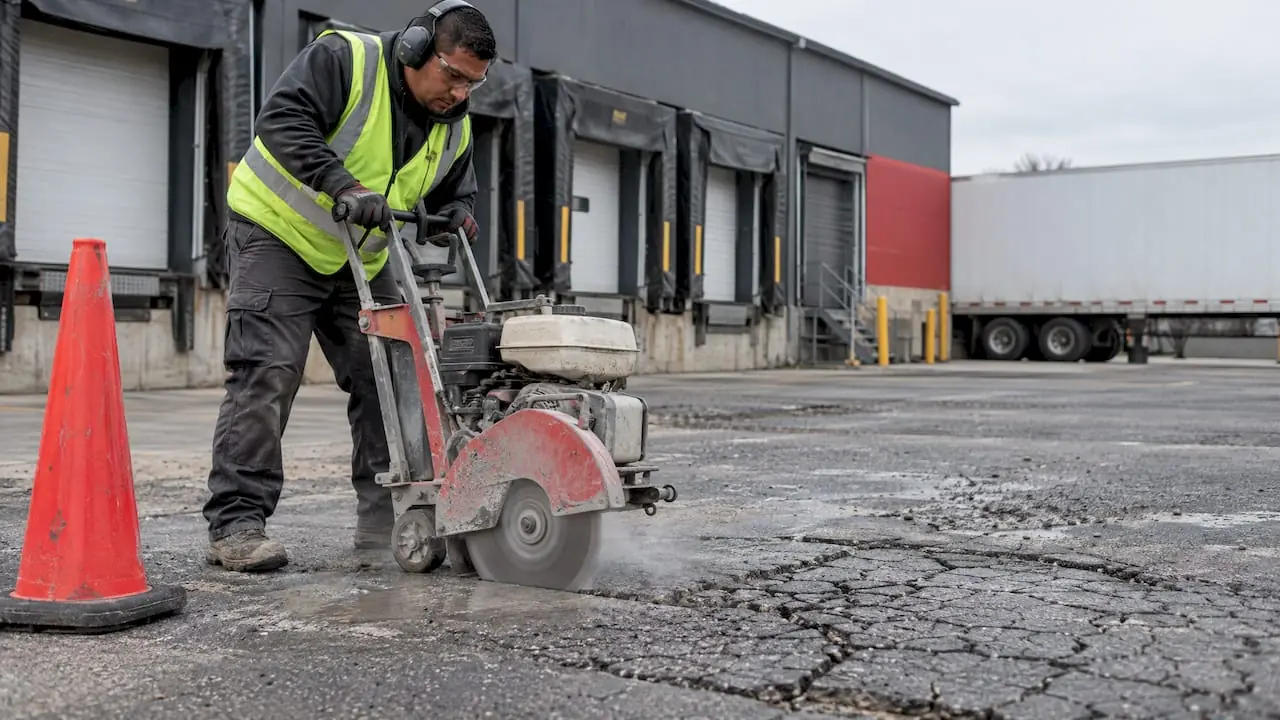
Alligator cracking is a structural failure, so the repair that lasts is almost always a patch or a rebuild, not a filler or a coat of sealer. Small, localized areas are dug out and patched. Large areas usually need an overlay strong enough to carry traffic, after the worst spots are patched full depth. Crack sealing and sealcoating belong on the pavement around the failure, where they protect what is still sound.
This guide is written for property managers, HOA boards and public-sector buyers who have to decide what to put in a bid or a budget. It covers how to recognize alligator cracking and tell it from other crack types, how to rate severity, which repair fits which condition, and how to keep it from coming back.
TL;DR
-
Alligator cracking forms in wheelpaths from repeated loading over a weak base or thin pavement. It is structural, so the fix has to reach the layer that failed.
-
Rate severity first. Low and early cracking can sometimes be treated at the surface. Medium and high severity call for digouts, full-depth patches or an overlay.
-
Crack sealing alone is generally ineffective once the full alligator pattern has developed.
-
Fix water and base problems before you patch, or the patch fails in the same spot.
-
Preventive work in the first years of a pavement’s life costs far less than dig-out patching later.
Table of Contents
How to recognize alligator cracking
Alligator cracking, also called fatigue cracking, shows up where tires run. The WSDOT field rating manual describes it as starting with parallel longitudinal cracks in the wheelpath. With more traffic these branch and interconnect into many-sided, sharp-angled pieces less than 2 feet (0.6 m) across. That chicken-wire look is what gives it the name.
It helps to separate it from the other cracks you see on a lot:
| Crack type | What it looks like | Where | What it tells you |
|---|---|---|---|
| Alligator (fatigue) | Interconnected, many-sided pieces under 2 ft | Wheelpaths, often drive lanes and turning areas | Structural failure from load |
| Block | Roughly rectangular blocks | Across the surface, not tied to traffic | Not load-associated, per WSDOT |
| Single longitudinal crack in a wheelpath | One line, may meander | Wheelpath | Possible early stage of alligator cracking |
The last row matters. Caltrans uses the label Alligator A for longitudinal cracking in the wheelpath, Alligator B for multiple interconnected cracks in the wheelpath, and Alligator C for interconnected cracking across the entire roadway, according to its MTAG crack treatment chapter. A single wheelpath crack that looks harmless can be the first stage of the same failure.
A practical field test: look at where the cracking sits. If it follows the tire paths at a loading dock, a drive aisle entrance or a fire lane, think fatigue. If it forms a grid of rectangles across an open, lightly trafficked area, think block cracking from aging, which calls for a different treatment.
Why alligator cracking forms
The Washington Asphalt Pavement Association explains that cracking begins at the bottom of the asphalt layer, where tensile stress and strain are highest under a wheel load. The cracks work their way up to the surface. The causes it lists are:
-
Loss of base, subbase or subgrade support
-
Stripping in the asphalt
-
Increased loading beyond what the pavement was designed for
-
Inadequate design
-
Poor construction
The Maryland guidelines add inadequate thickness and debonding between asphalt layers. TxDOT points to inadequate base support or a brittle surface. Caltrans notes in Appendix B that a saturated base or subgrade is a probable cause.
For a commercial property, this translates into familiar situations: a lot built for passenger cars that now sees delivery trucks and refuse haulers, a drainage problem that keeps the base wet, or a thin section laid over weak soil. Montana winters add freeze and thaw to that list, which is why base and drainage deserve attention on any Northern Rockies site. We cover that in why asphalt fails early in Montana.
The consequence of ignoring it is predictable. Per Caltrans, alligator cracks typically develop into potholes and pavement disintegration if not repaired. TxDOT notes that the cracks let surface water reach the subgrade and further destroy its stability, which speeds the whole process.
Rate the severity before you choose a repair
Severity drives the scope. The WSDOT manual defines three levels:
-
Low: thin, branched, discontinuous cracks that are just beginning to interconnect, with no spalling.
-
Medium: cracking is completely interconnected in a fully developed alligator pattern, with some spalling at the edges. Cracks may be wider than 1/4 inch, but the pieces are still in place.
-
High: a well-developed pattern with obvious spalling. Individual pieces are loose and rock under traffic, some may be missing, and fines may pump up through the cracks.
Extent matters as much as severity. WSDOT suggests recording it as a percentage of wheelpath length or in square feet of survey area, using ranges of 1 to 9%, 10 to 24%, 25 to 49% and 50 to 100% of both wheelpaths. For a property manager, that gives you a consistent way to compare lots in a portfolio and to put a number in a capital plan instead of a vague “it looks bad.”
Look below the surface
The Washington Asphalt Pavement Association recommends investigating fatigue-cracked pavement by digging a pit or coring it. That shows the structural makeup of the pavement and whether subsurface moisture is contributing. Maryland’s guidelines add that for high-severity cracking you should check whether the surface has debonded from the base. If it has, the surface should be removed rather than patched.
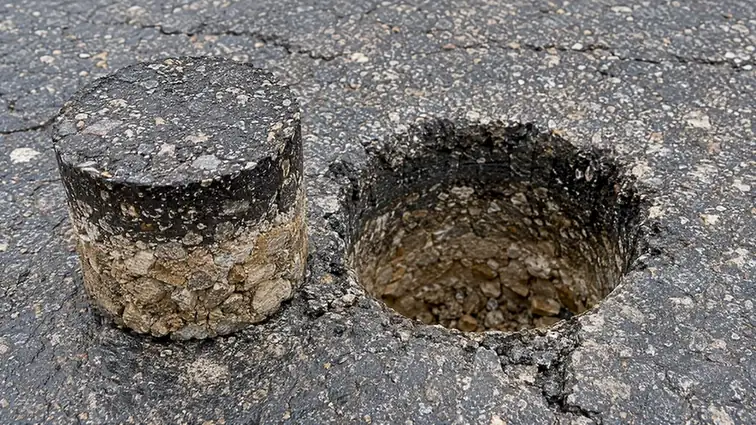
This is the step that separates a repair from a repeat. Patching over a wet or weak base gives you a new patch with the old problem under it.
Repair options, matched to the condition
There is no single best fix. The right one depends on severity, extent and what the investigation finds.
| Condition | Typical repair | Source |
|---|---|---|
| Small cracks (under 0.25 in.), not yet interconnecting or spalling | Surface treatment such as chip, fog, sand or scrub seal. It does not add structural capacity, and fatigue cracking may continue | New Mexico DOT manual |
| Not extensive, no visible subgrade, no depressions | Chip seal is possible, but partial-depth or full-depth patching is the typical method | WSDOT Maintenance Manual |
| Widespread cracking with aging and oxidation | Mass crack sealing such as a scrub seal or geosynthetic reinforced chip seal, with digouts at medium or high severity | Caltrans MTAG |
| Small, localized cracking from lost subgrade support | Remove cracked pavement, replace poor subgrade, improve drainage if needed, then patch | Hawaii Asphalt Paving Industry guide |
| Large areas showing general structural failure | Overlay across the pavement, strong enough to carry the loading | Hawaii Asphalt Paving Industry guide |
| High severity | Full-depth patch before any overlay | Hawaii Asphalt Paving Industry guide |
Two details deserve emphasis. First, New Mexico DOT notes that the underlying fatigue-cracked pavement most likely contributes little or no strength, so an overlay has to be designed as if it will carry the load itself. Second, Maryland warns that a thicker-than-existing patch may be needed, because matching the existing thickness can be structurally insufficient.
Why not just fill the cracks?
Crack sealing is a strong tool in the right place. It is just the wrong tool for this failure. Caltrans states that crack sealing will not treat the structural failure behind alligator cracks. The Washington Asphalt Pavement Association says that once the characteristic alligator pattern is apparent, crack sealing is generally ineffective.
That is also why it pays to seal the single cracks that surround a failed area. They are the ones sealing can still protect. If you are weighing what belongs where, our guide on sealcoat, asphalt repair or repaving walks through the decision.
How a full-depth patch is done
Caltrans calls a deep patch the recommended permanent repair, with hot mix asphalt placed full depth to give a strong patch. The steps below follow the Terracon repair guide and the Caltrans and Texas guidance.
-
Mark the area. Cut the limits to extend at least 12 inches beyond the edge of the distressed area in all directions.
-
Remove the cracked pavement. Saw the edges so the patch has clean, vertical faces.
-
Deal with the base. Where the base is unstable or wet, TxDOT says it must be removed, replaced or stabilized. Excavate poor subgrade and replace it with granular select fill or asphaltic base material.
-
Fix drainage. Caltrans says that when water is a factor, drainage should be corrected first. Removing wet material and installing needed drainage is part of the correction.
-
Tack the surfaces. Apply tack coat to the granular fill and all sawed edges.
-
Place and compact the hot mix. Match the existing pavement, and make the patch thick enough for the loading.
Skipping step 3 or step 4 is the most common reason a patch fails. If the water that softened the base is still there, the new asphalt only buys time.
When to consider an overlay or resurfacing
When fatigue cracking covers a large share of the lot, a patchwork of digouts can cost more than treating the whole surface. The guidance above points to a structural overlay over the entire pavement, with high-severity areas patched full depth first. A lot with 50 to 100% of both wheelpaths affected is a candidate for that conversation, and so is a lot where cores show a thin or wet section.
For scoping and phasing, including how to split work across budget years without leaving failed areas to deteriorate, see small asphalt repairs or full repaving and the sealcoating vs. repaving cost guide.
Weather and timing
Patching and crack work are weather-sensitive. The Montana Department of Transportation crack sealing manual recommends sealing only when surface temperatures are between 35°F and rising and 120°F. Ideal conditions are 35°F and rising with relatively low humidity and little or no wind. Sealant should never go down in rain. MDT also notes that the best results come in cooler weather, early spring and late fall, when cracks are open to their best width.
On the sealing side, MDT recommends cleaning routed and non-routed cracks with high-pressure compressed air at 100 PSI. Caltrans adds that in cooler, damp conditions a hot lance can dry and preheat the crack area. The Asphalt Paving Handbook says cracks narrower than 3/8 inch are unlikely to take sealant, which pools on the surface instead. Such cracks should be widened with a mechanical router first.
For Northern Rockies owners, the practical message is to schedule structural repairs and perimeter crack sealing in the shoulder seasons when conditions allow, and to plan around a short window instead of waiting for a failure in January. Our 2026 pavement budget guide for Montana property managers helps put those windows into a yearly plan.
How long repairs last
Durability depends on whether the cause was fixed. Caltrans notes that the cause and activity of a crack play a dominant role in whether sealing or filling succeeds. Citing FHWA data, it reports 2 to 4 years of service from emulsions or asphalt materials flush-placed in unrouted cracks, and 6 to 8 years from hot-applied rubber asphalt sealant placed flush or overbanded. Those figures describe crack treatments around the failed area, not a structural fix.
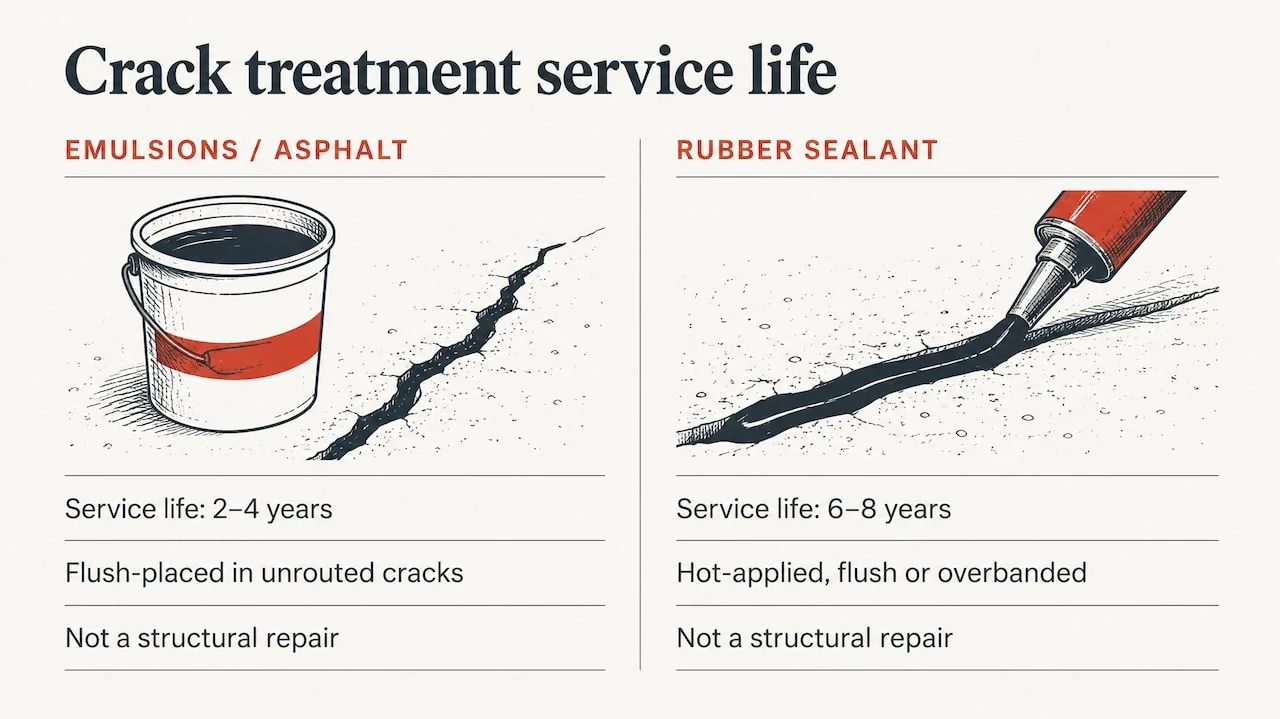
A properly built full-depth patch, with the base and drainage corrected, is judged on the structure beneath it, not on the sealant at its edge. Any quoted life for a patch or overlay should come with the investigation findings that support it.
Preventing a repeat
Prevention is cheaper than repair. WSDOT’s maintenance manual says preventive programs started early, in the first 1 to 3 years of a pavement’s life, greatly improve service life. It estimates HMA dig-out patching at nearly 12 times the cost of crack sealing. Caltrans calls crack sealing a cost-effective preventive tool and says advance crack sealing can extend the life of surface treatments such as chip seals.
A sensible program for a commercial lot looks like this:
-
Inspect every year, ideally in spring after the freeze-thaw cycle, and log wheelpath cracking by severity and extent.
-
Seal single cracks early, before they interconnect.
-
Keep water moving off the lot. Clear drains and fix ponding.
-
Plan for heavier loads. If trucks now use a lot designed for cars, flag those lanes.
-
Treat the surface on a schedule so oxidation does not make the pavement brittle.
See our notes on why delaying pavement maintenance costs more, crack sealing and costly repairs and spring traffic damage to weakened asphalt.
Our perspective
Most of the alligator cracking we are asked about was not caused by the surface. It was caused by what is under it, and by how long the lot went without a plan. A bid that only quotes surface work for a fatigue-failed area is a bid you will pay for twice.
That is why we start with a detailed assessment tied to your operating schedule, not a one-size price. We look at where the cracking sits, how far it has progressed, and what drainage and base conditions are doing. Then we write the scope so each treatment goes where it works: patching and resurfacing for failed zones, crack sealing and sealcoating for the sound pavement around them.
Because we make our own sealcoat locally and plan around the season, we can sequence repairs and protective coats so they are not fighting the weather. For public-sector and HOA work, we build proposals to be bid-ready and in line with municipal procurement standards, so the board or procurement officer can compare like with like.
Summit Surface Partners Team
Get the right scope for your lot
If you have wheelpath cracking you want assessed, we handle asphalt repair, patching and resurfacing for commercial properties, HOAs, contractors and public-sector owners across the Northern Rockies. We pair that with parking lot resurfacing, crack sealing and sealcoating and ongoing parking lot maintenance, so the whole lot is treated in one plan.
Send us the address and what you are seeing, and we will build a bid-ready proposal around the actual condition of the pavement.
FAQ
How do you repair asphalt alligator cracking?
It depends on severity and extent. Small, localized areas are cut out at least 12 inches beyond the distress, the poor subgrade is replaced, and the area is patched with hot mix. Large failed areas usually need an overlay strong enough to carry traffic, with high-severity spots patched full depth first. Crack sealing is generally ineffective once the full alligator pattern has formed.
Can I just seal or sealcoat over alligator cracks?
Not as a lasting fix. Surface treatments can fill small cracks under 0.25 inch that have not begun to interconnect, but they add no structural capacity and fatigue cracking may continue, according to New Mexico DOT. Once the pattern is established, the failed pavement needs patching or replacing.
How long does a repair last?
It depends on whether the cause was corrected. FHWA data cited by Caltrans gives 2 to 4 years for emulsion fills in unrouted cracks and 6 to 8 years for hot-applied rubber asphalt sealant. A full-depth patch with sound base and drainage is a structural repair, and its life depends on that foundation.
What is the difference between alligator cracking and block cracking?
Alligator cracking sits in the wheelpaths and forms pieces under 2 feet with sharp angles, driven by traffic loading. Block cracking forms roughly rectangular blocks and is not load-associated. The treatments differ, so identify which one you have before bidding.
When is the best time of year to do the work?
For crack sealing, MDT recommends surface temperatures between 35°F and rising and 120°F, in dry conditions, with spring and late fall giving the best results. Structural patching also needs dry weather, so Northern Rockies owners should plan repairs in the shoulder seasons.
Sources
-
WSDOT Pavement Surface Condition Field Rating Manual for Asphalt Pavement
-
Washington Asphalt Pavement Association: Alligator (Fatigue) Cracking
-
Asphalt Paving Handbook: Surface Preparation for Asphalt Overlays