
Parking Lot Pothole Repair: Methods, Costs and Timing in Montana
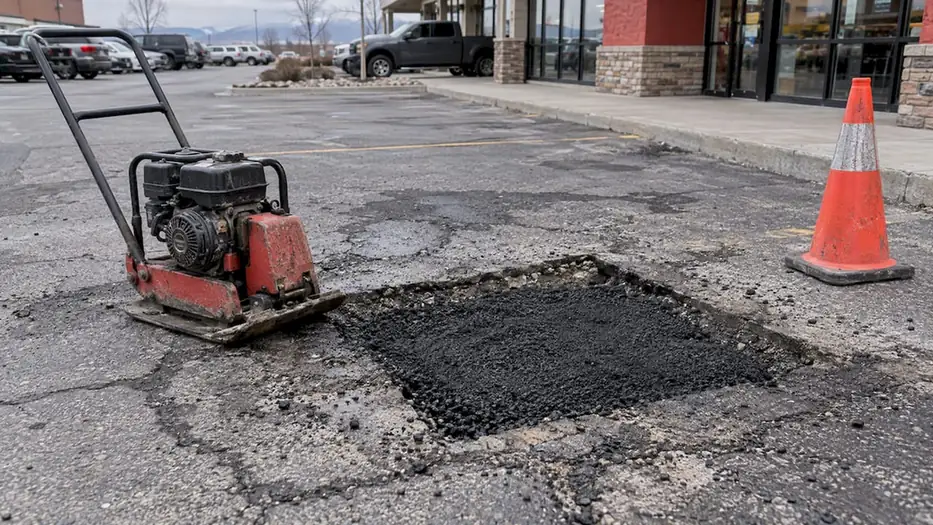
A parking lot pothole that lasts is cut out square, taken down to firm support, tacked and filled with compacted hot mix asphalt. A pothole that returns in a few months was usually filled over water, loose debris or a weak base. For property managers in Montana and the Northern Rockies, the real decisions are which method fits the failure, when the work can be done in our climate, and what drives the price.
This guide covers how potholes form, the repair methods contractors use, what to expect from a commercial crew, how cost is built up, and the liability questions that make fast action worthwhile.
TL;DR
-
Potholes are the end stage of other pavement distress: cracking, raveling and failed joints or patches. Fix the cause, not only the hole.
-
A permanent repair removes failed material past the visible damage, cuts square edges, tacks the sides and bottom, and fills with compacted dense-graded hot mix.
-
Cold patch is a winter stopgap. Plan the permanent repair for the warm season, when hot mix can be placed and compacted properly.
-
Cost depends on size, depth, base condition, weather, labor, equipment and mobilization, so grouping repairs into one visit is usually the efficient way to buy them.
-
The party controlling the lot can carry liability for an unaddressed pothole, so document and barricade hazards right away.
Table of Contents
Why potholes form in commercial lots
The Asphalt Institute describes potholes as bowl-shaped holes from localized break-up of the pavement, typically the result of continued deterioration from other distresses such as segregation, raveling, alligator cracking, or failures at joints or patches. In other words, a pothole is rarely the first problem. It is the last stage of a sequence.
In the Northern Rockies that sequence is driven by water and temperature swings. A crack opens, meltwater gets into the base, and freeze-thaw cycles pump it back out under traffic. Delivery trucks, snow plow blades and trash haulers do the rest. By the time a hole appears, the base under it is often wet and soft, which is why a quick shovel-and-tamp fill so often fails.
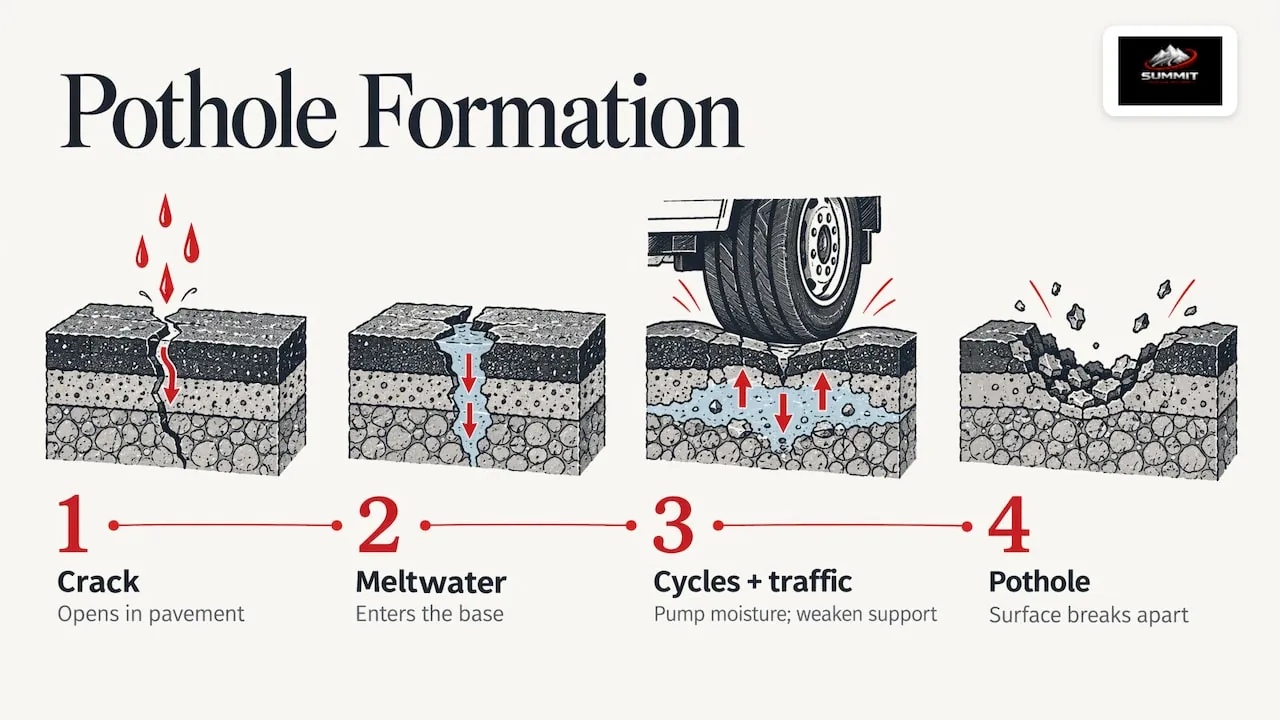
This matters for budgeting. If you see alligator cracking or open joints around a pothole, the repair area is larger than the hole. If you see isolated cracks, sealing them early can keep many potholes from forming at all, which is the logic behind crack sealing as a routine line item.
The repair methods, from stopgap to permanent
A 2016 review of pothole patching materials and methods from the Illinois Asphalt Pavement Association and Bradley University identifies four common techniques: throw-and-go, throw-and-roll, semi-permanent and spray-injection. It notes the semi-permanent procedure is often considered the best option short of full-depth replacement, with exceptional longevity at the cost of more labor and equipment.
| Method | What it is | Best use | Expected result |
|---|---|---|---|
| Throw-and-go | Material placed in the hole and left to traffic compaction | Emergency, safety hazard | Short-lived |
| Throw-and-roll | Material placed, then compacted with a truck tire or roller | Winter or fast response | Better, still temporary |
| Semi-permanent | Debris removed, edges squared, material placed and compacted | Warm-season repairs | Long service life |
| Full-depth cut-out | Failed pavement and weak base removed, tacked, refilled in lifts | Base failure, clusters of potholes | Longest service life |
| Spray-injection | Aggregate and emulsion blown into a cleaned hole | Quick municipal-style repair | Varies |
For private commercial lots, the semi-permanent and full-depth approaches are the ones that protect your investment, because you are paying for the same mobilization either way.
What a permanent repair looks like, step by step
The Asphalt Institute repair guide lays out the standard approach. In practice, a well-run crew follows this order:
-
Assess and protect the area. Mark the full extent of distress, not only the visible hole, and set cones or barricades so traffic and pedestrians stay clear.
-
Remove failed material. Cut out to the depth needed to reach firm support, including part of the subgrade if necessary. The removal extends beyond the visible damage.
-
Cut square. The cut-out is rectangular with square, vertical edges. Round holes leave thin, feathered edges that break up again.
-
Clean and tack. The vertical edges and the bottom are tacked so the new mix bonds to the old pavement.
-
Fill with hot mix. Dense-graded hot mix asphalt is the specified material, with cold patching mix used only if hot mix is not available. Holes deeper than 6 inches get the mix placed in two layers.
-
Compact. Compaction is what makes the patch dense and watertight. Each lift needs it.
-
Reopen and follow up. Check the patch after the first weeks of traffic and after the first freeze-thaw cycle.
The Minnesota DOT’s Asphalt Patching Methods Best Practices Manual agrees on the core points: virgin hot-mix asphalt during the regular season for any depth, and multiple lifts with compaction after each when the patch is deeper than 4 inches. It also names mastic as the best option for low-depth, narrow potholes, under 3 inches wide and under 2 inches deep, along longitudinal joints. Minnesota is a cold-climate state, so its guidance translates well to Montana conditions.
Why the cut-out matters more than the material
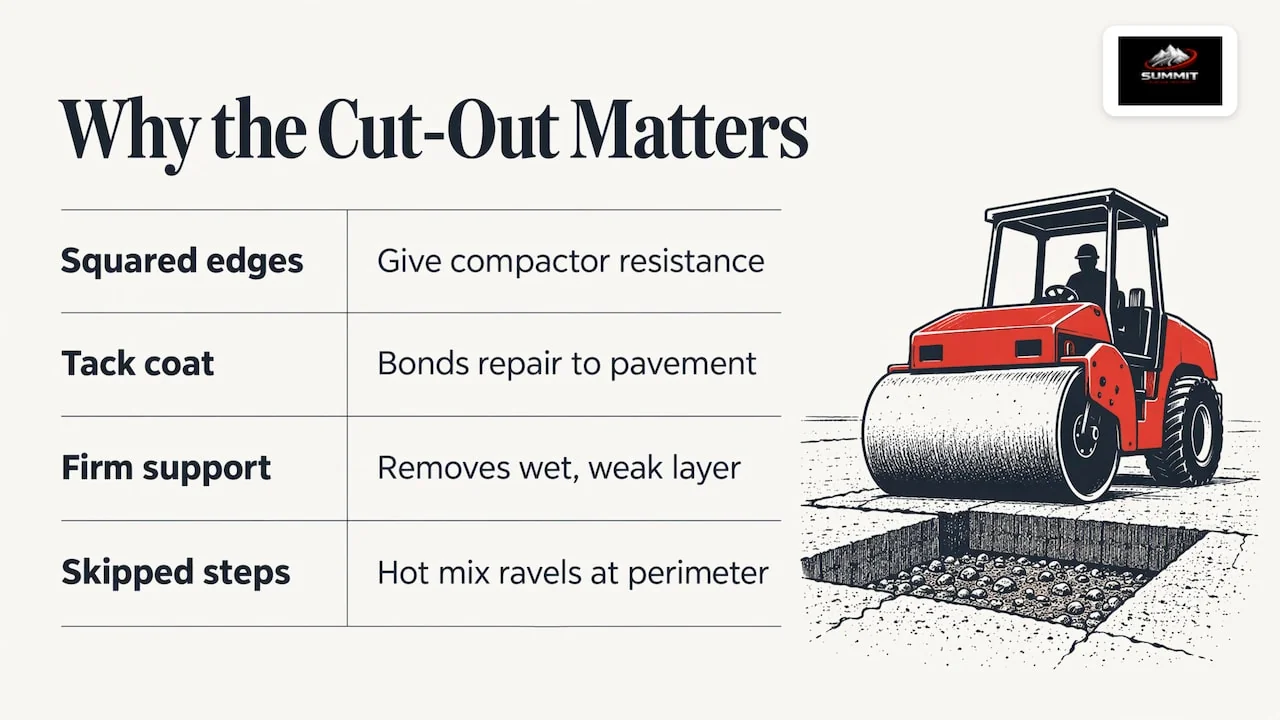
Contractors and managers both tend to focus on the patch mix. The cut-out does more of the work. Squared edges give the compactor something to push against, tack coat bonds the repair to the surrounding pavement, and digging down to firm support removes the wet, weak layer that caused the failure. Skip those steps and even good hot mix will ravel at the perimeter.
Timing: cold-weather patching in the Northern Rockies
Hot mix needs to be hot when it is placed and compacted. In a Montana winter, that is usually not possible, and asphalt plants typically wind down for the cold months. That leaves two realistic tracks:
-
Winter: Use a cold patch to make the hole safe and keep water out. Treat it as temporary and note the location for follow-up.
-
Spring through fall: Schedule permanent hot-mix repairs once the ground has thawed and the plant is producing. Early spring is when most potholes show themselves, and also when crews book up, so putting your property on a list before the thaw helps.
Because we plan work around the season, we build repair schedules that tie patching to the weather window instead of forcing it into the wrong week. Patching also belongs before sealcoating or striping in the sequence, so the surface treatment covers sound pavement. Our parking lot maintenance programs are organized around that order.
What to expect from a commercial pothole repair service
A professional commercial crew should offer more than a truck and a bag of mix. Here is what a property manager should see in a good proposal and process:
-
A site assessment. Someone walks the lot, marks every failed area, and identifies whether the cause is a crack, drainage, a utility cut or base failure.
-
A scope that matches the defect. Surface patches for shallow raveling, full-depth cut-outs for base failure, and a recommendation for overlay or resurfacing when failures are widespread.
-
A clear schedule around your tenants. Repairs in busy lots are often staged by section or done off-hours so access to the entrances is kept.
-
Written scope and pricing. For public sector work, that includes proposals that meet municipal procurement standards.
-
Safety setup. Barricades, signage and an ADA-aware plan so accessible routes stay usable.
If patching is part of a bigger picture, such as drive aisle failures or a lot near the end of its life, our guide to asphalt repair options for Montana commercial properties helps you compare patching, overlay and replacement.
What drives pothole repair cost
We do not publish prices in articles, because every lot is different and a figure copied from a national average would mislead you. What you can rely on is the list of factors. One construction-industry repair guide says costs vary with size, depth, ground conditions, weather, and materials and labor, and that labor, equipment and mobilization are the largest price factors.
That last point is the most useful for a manager. The asphalt in a single small patch is a minor part of the cost; the crew, the truck, the saw and the compactor arriving at your lot are most of it. Two practical consequences follow:
-
Bundle repairs. Ten small patches done in one visit spread mobilization across all of them. Ten separate call-outs do not.
-
Fix the cause early. A crack that is sealed costs far less to handle than the pothole it becomes, and a full-depth repair costs less than repeated temporary fills in the same spot.
Other variables that move a quote:
| Factor | Why it matters |
|---|---|
| Depth and base condition | Soft base means deeper cut-out and more mix, sometimes in two lifts |
| Number and spacing of patches | Clustered repairs reduce set-up time per patch |
| Access and traffic control | Busy lots need staging, barricades and off-hour work |
| Season | Hot mix availability and weather affect scheduling |
| Distance and remote location | Mobilization across Northern Rockies distances adds up |
| Follow-on work | Sealing, striping and crack work are most efficient in the same visit |
This is also why a free assessment is better than a phone quote from a photo. Square footage depends on what is under the visible hole.
Who is responsible for a parking lot pothole
In general, the party that controls the lot carries the duty to keep it reasonably safe. A St. Louis injury law firm explains that responsibility can fall on the property owner, a business tenant, or a maintenance company hired to keep the lot safe. A New York firm makes the same point for its state: owners or managers controlling the lot have a duty of care, and potholes or uneven surfaces can create liability. These are examples from other states. Liability rules differ by state and lease, so for a specific situation in Montana, Idaho or Washington, talk to your attorney and insurer.
Some municipalities also set repair deadlines and barricading rules for hazardous potholes in paved parking areas. Requirements differ by town, so check your city or county property maintenance code.
A sensible policy for any manager:
-
Inspect the lot after the thaw and after major storms.
-
Photograph and log each hazard with a date.
-
Barricade or temporarily patch anything dangerous right away.
-
Schedule the permanent repair and keep the work order on file.
Where patching fits in a longer plan
Patching is the repair layer of a maintenance program, not the whole thing. When a lot has isolated failures and a mostly sound surface, patching plus crack sealing and sealcoating usually makes sense. When failures are spread across the lot, an overlay or full resurfacing is the better use of budget. Our commercial parking lot paving team can assess which side of that line your property sits on. For long-range budgeting, the commercial parking lot ROI guide shows how to compare repair spending against replacement. HOA boards planning multi-year work can start with our HOA pavement maintenance programs overview.
After patching, restriping restores stall lines and accessible routes. Our ADA striping checklist covers what to confirm so repaired areas stay compliant.
Perspective
Most pothole calls we get are really base and water problems wearing a pothole’s face. The cheapest repair on paper, a quick fill, is often the most expensive over three seasons, because the same hole comes back and the crew has to mobilize again.
We would rather walk your lot first. Our assessment process looks at why each failure formed, separates what needs a full-depth cut-out from what a surface patch can handle, and lays out a schedule around the Northern Rockies weather window and your tenants. The patching, crack sealing and sealing that follow can be planned as one sequence rather than three separate vendors.
For property managers and public sector buyers, we write proposals to be bid-ready and clear on scope and timing, so you can compare them honestly and get the work approved.
Summit Surface Partners Team
Get your lot assessed by Summit Surface
Summit Surface Partners, based in Kalispell, handles asphalt repair and patching for commercial properties, HOAs, contractors and public sector customers across the Northern Rockies, along with crack sealing, sealcoating, striping and seasonal snow removal. Every job starts with a detailed assessment tailored to your operating schedule.

If your property also needs industrial or restoration cleaning, our sister brand Summit Cryo at summit-cryo.com handles dry ice blasting.
FAQ
What is the best way to repair a parking lot pothole?
Cut out the failed material beyond the visible damage, down to firm support, with square edges. Tack the sides and bottom, then fill with compacted dense-graded hot mix asphalt, in two layers if the hole is deeper than 6 inches. This follows the Asphalt Institute’s guidance.
Can potholes be fixed in winter in Montana?
Yes, but only as a temporary measure. Cold patch can make the hole safe and keep water out, while permanent hot mix repairs are best scheduled once the weather warms and hot mix can be properly compacted. Log winter patches so they get a permanent fix in spring.
How much does commercial pothole repair cost?
It depends on size, depth, base condition, weather, labor, equipment and mobilization, with labor, equipment and mobilization the largest factors according to one construction-industry guide. Grouping several repairs into one visit usually spreads that mobilization cost. A free on-site assessment gives you a number for your actual lot.
Who is responsible for a pothole in a private parking lot?
Generally the party controlling the lot: the owner, a tenant or a maintenance contractor, depending on the lease and contract. Rules vary by state and city, so confirm your obligations with your attorney and insurer, and barricade known hazards promptly.
Request a free estimate
If you manage a commercial property, HOA or public facility in Montana, Idaho or Washington, call or email Summit Surface Partners through summit-surface.com for a free estimate on parking lot pothole repair.
Sources
-
Asphalt Institute: Repair of Asphalt Parking Lots and Driveways
-
Minnesota DOT: Asphalt Patching Methods Best Practices Manual
-
IAPA / Bradley University: Pothole Patching, A Review on Materials and Methods
-
Construction industry guide: Pothole Repair Basics
-
Injury law firm (Missouri): Slip and Fall Accidents in Parking Lots
-
Injury law firm (New York): Parking Lot Pedestrian Accidents
-
Local property maintenance codes vary by municipality