
Pavement Condition Assessment: A Property Manager’s Guide
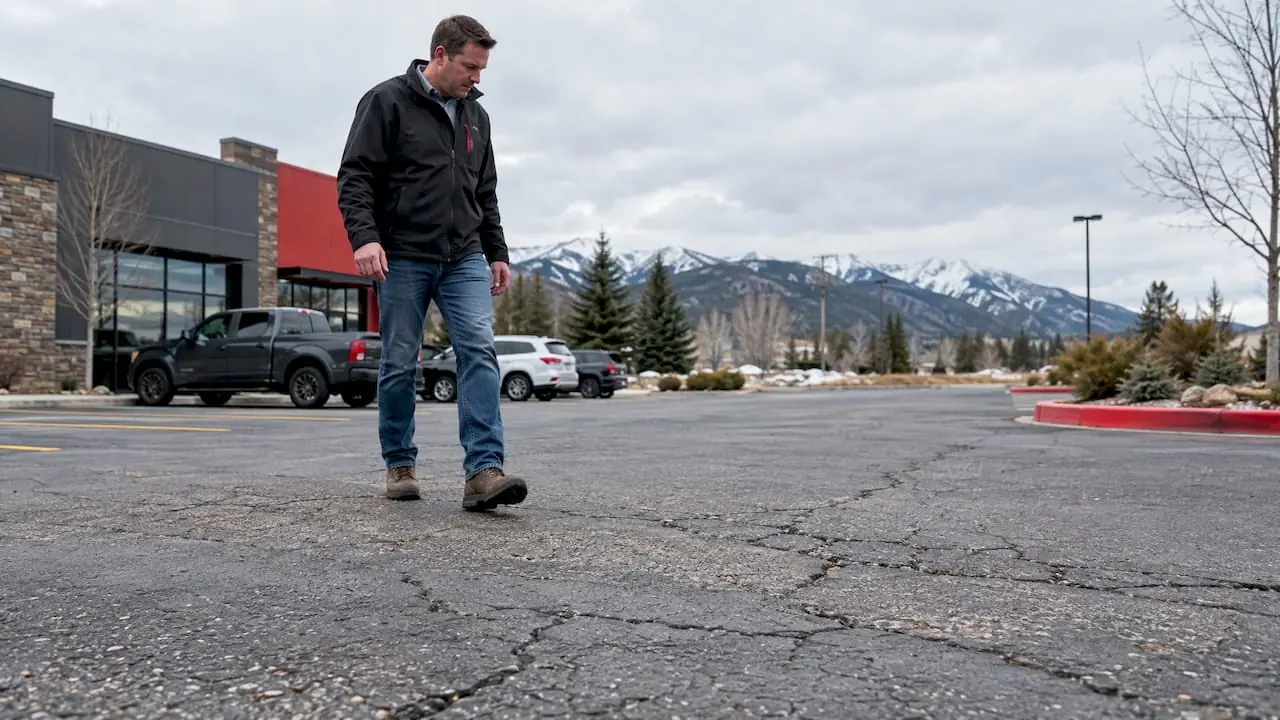
A pavement condition assessment is a systematic inspection of your asphalt or concrete surfaces. Inspectors identify each distress, record how severe it is and how much of the area it covers, then turn those findings into a rating and a maintenance priority list. If you manage a parking lot, a private road network or an HOA community, it is the document that tells you what to fix now, what to preserve and what to budget for next.
TL;DR
-
An assessment records three things for every defect: its type, its severity and its extent. Ratings such as PCI (0 to 100) and PASER (1 to 10) summarize them.
-
Large areas are divided into sections and sample units, so a few hundred square feet can represent a whole lot reliably.
-
Inspect on dry pavement and at a similar time of year each cycle, so results can be compared year to year.
-
A useful report maps conditions, rates each section and links every rating to a treatment, so it can feed a budget or a bid package.
-
Summit Surface Partners offers detailed, season-aware assessments for commercial properties, HOAs and public sector buyers across the Northern Rockies.
Table of Contents
What a pavement condition assessment actually is
Think of it as a medical chart for your pavement. A trained rater walks or drives the surface, notes the defects and converts them into numbers. The Washington State DOT field rating manual says the elements of a condition rating are the type of defect, its severity and the extent to which the surface is affected. Everything else in the process, from sampling to reporting, exists to make those three observations consistent and repeatable.
The purpose goes beyond a snapshot. A pavement engineering group in Michigan describes condition assessment as the basis for a network-wide metric, modeling future condition, deciding what work to do and judging the value of fixes and the funding impact. For a property manager, that translates into three questions the assessment should answer:
-
What shape is each lot, drive aisle or road in today?
-
Which treatment fits each area: crack sealing, sealcoating, patching, resurfacing or full reconstruction?
-
In what order and in which budget year should the work happen?
Condition assessment, survey and evaluation: the same family
People search for pavement condition assessment, survey and evaluation almost interchangeably, and in practice the words overlap. A few distinctions are useful:
-
Survey usually means the data collection itself: the walk-through or drive-through where distresses are counted and measured.
-
Assessment adds the rating and interpretation: turning the survey data into an index and a condition grade.
-
Evaluation often points to a deeper, project-level look at a specific area, sometimes including structural or functional testing, to decide on a treatment.
The Washington manuals and Australian road guidance use different vocabulary, but the logic is shared. The Western Australian Local Government Association manual, for example, describes a consistent, repeatable method for visual condition assessments, covering defect identification and measurement, condition indices and maintenance prioritisation. That is the same job whether the pavement is a county road or a 200-stall retail lot.
What inspectors record: type, severity and extent
FHWA guidance says rating protocols should clearly define distress types, severity levels, rating methods (count, length or area), the reporting interval and how condition values are computed. Without those definitions, two inspectors will rate the same lot differently.
Distress type
For asphalt, the usual list covers alligator (fatigue) cracking, block and transverse cracking, potholes and patching, rutting, raveling and weathering, and edge or joint problems. Each one points to a different cause. Block cracking and weathering often signal age and oxidation at the surface. Alligator cracking and rutting usually point to problems in the base or subgrade, which surface treatments alone cannot correct. Our guide on why sealcoat cannot fix a failing foundation walks through that distinction.
Severity
Severity is typically low, moderate or high. The Nebraska Department of Roads survey manual notes that grid or block cracking and transverse cracking also have an extra-high severity category. Agencies define the thresholds differently, so a report should always state which definitions it used.
Extent
Extent describes how much of the area is affected. The same Nebraska manual defines extent bands for bituminous pavements:
| Extent category | Share of area affected |
|---|---|
| Absent | None |
| Trace | Less than 10% |
| Occasional | About 10 to 30% |
| Frequent | About 30 to 50% |
| Extensive | About 50 to 80% |
| Complete | More than 80% |
WSDOT adds that agencies choose whether to record the extent of the predominant severity or the extent of each severity. For a lot with mixed damage, recording each severity separately gives a more accurate repair quantity.
How a lot or road network is divided and sampled
You do not need to measure every square foot to rate a large pavement reliably. You need a sound sampling plan.
The ASTM D6433 procedure for roads and parking lots, as summarized by a pavement survey provider, divides the pavement into branches (each roadway or parking area is its own branch), then sections based on design, construction history, traffic and condition, then sample units. The minimum number of sample units for 95% confidence comes from a statistical formula, and sampling is systematic, with the first unit chosen at random.
Section size matters too. The City of Issaquah, Washington, defines a network-level sample area as 2,500 square feet, plus or minus 1,000, and treats a section as the smallest unit for choosing maintenance and repair treatments. For road segments, New York State DOT groups lengths with similar pavement type, width, lanes, maintenance history and condition, and calls segments of about 0.5 to 1.0 mile optimal.
What this means for a property:
-
A lot that was paved in two phases should be two sections, even if it looks uniform.
-
A heavily trafficked entrance and a rarely used rear corner should not be averaged together.
-
Truck lanes, dumpster pads and drive-through lanes deserve their own sections because they fail on a different timeline.
PCI and PASER: how ratings are assigned
Two systems dominate in the United States.
Pavement Condition Index (PCI). PCI is a numerical index from 0 to 100, developed by the US Army Corps of Engineers and based on a visual survey of the number and types of distresses. A value of 100 is the best possible condition and 0 the worst. The procedure is described in ASTM D6433 and is widely used for roads and parking lots.
PASER. The Pavement Surface Evaluation and Rating system uses a 1 to 10 scale. Per the Louisiana LTAP field guide, 10 is new construction under a year old with no visible defects, ratings step down through Very Good, Good, Fair, Poor and Very Poor, and 1 is Failed, with each rating tied to distress descriptions and recommended treatments.
The same source distinguishes the two by how much they record: simple systems such as PASER give one overall rating without recording individual distress measures, while complex systems such as PCI provide component measures of distresses.
| PCI | PASER | |
|---|---|---|
| Scale | 0 to 100 | 1 to 10 |
| Detail recorded | Each distress, severity and quantity | One overall rating |
| Typical use | Parking lots, project and network planning, budget models | Quick network screening, road systems |
| Output | Numerical index, distress quantities | Condition grade with a treatment suggestion |
Two rating rules from the Louisiana guide are worth knowing. Raters should score the current surface condition, not the distress they expect in the future. And they should rate the worst lane, because that lane drives the repair decision.
There is also no single global standard for reporting. Irish guidance notes that results are often colour banded into red, amber, blue and green to make them easier to read, with each band tied to a treatment. A color-coded site map in your report does the same job for a lot.
When a visual inspection is enough, and when it is not
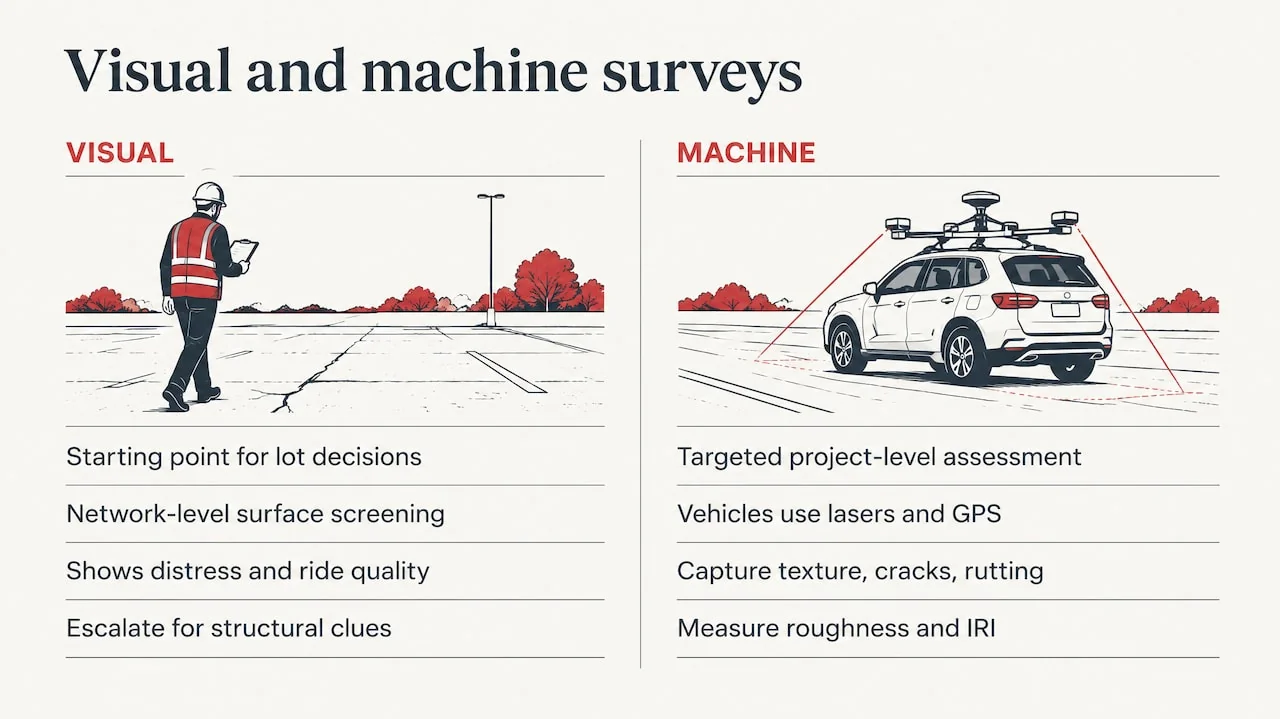
For most commercial lots, a visual assessment is the right tool for deciding between preservation and repair. Agencies work the same way: New York State DOT limits network-level assessment to certain surface distresses and ride quality because tools for measuring structural capacity and friction are not efficient at network scale. A more detailed project-level assessment follows once candidate projects are identified.
The Irish survey standard describes the same two-tier pattern, with extensive visual surveys supported by targeted and more limited machine surveys. Machine surveys use vehicles with lasers and GPS to capture texture, cracking, roughness and rutting. The Australian manual also accommodates manual inspection, video-based capture and automated or AI-assisted tools, and reports roughness (IRI) as its own dataset.
A practical rule for property owners: a visual survey is the starting point, and a deeper look is warranted when the visible pattern suggests a structural cause. Widespread alligator cracking, rutting or recurring failures in the same spot are the usual triggers. At that point the question shifts from “which surface treatment?” to “what is under the surface?” and the scope of the work changes with it.
Timing and frequency
Condition ratings are only comparable if they are collected under similar conditions.
-
Dry pavement. WSDOT recommends rating at a similar time of year and only while the pavement is dry, because weather and season change how visible and severe some distresses look. Sun angle also matters, and inspectors should occasionally view the surface from more than one direction.
-
Slow speed. For windshield surveys, WSDOT suggests 2 to 5 miles per hour for observing defects.
-
After rain. Nebraska’s manual says data should not be collected during or immediately after rain.
In the Northern Rockies, where freeze-thaw cycles and snow cover limit the inspection window, this means scheduling a survey after the surface has dried out in spring or in the fall before snow, and repeating it in the same window each cycle. Cracks can be wider and easier to see when the ground has just thawed, but a bare, dry surface is what you need to rate accurately.
How often to repeat depends on use. Public agencies set the pace by road class. New York State DOT runs an annual windshield survey of cracking on its main routes. Australian local-government guidance suggests visual surveys every 2 to 3 years for higher-order sealed roads and every 3 to 5 years for lower-order ones. For private lots and HOA roads, those intervals are a useful frame: high-traffic and entrance areas merit a closer look more often than low-use parking.

What a useful report includes
A rating alone does not help you spend money. A report you can budget from, or attach to an RFP, should contain:
-
Scope and method. Which areas were inspected, which rating system was used, the date and the surface conditions.
-
A site map with sections. Each section labeled, sized and color-coded by condition.
-
Distress inventory. Type, severity and extent for each section, with quantities in square feet or linear feet.
-
A rating per section. PCI, PASER or a comparable grade, with the definitions used.
-
Photos. Tied to specific locations on the map.
-
Recommended treatment per section. Crack sealing, sealcoating, patching, mill and overlay or reconstruction, with a priority order.
-
A multi-year plan. What happens this season, next season and in three to five years, with quantities that a contractor can price.
That last item is what separates a report from a plan. Our guide to writing a pavement maintenance RFP shows how to turn these quantities into a bid package that contractors can price on equal terms, and the Montana pavement budget guide shows how to carry them into an annual budget.
From findings to a maintenance plan
Condition ratings map onto treatments in a fairly predictable way.
-
Good condition, minor cracking. Preservation territory. Crack sealing keeps water out of the base, and sealcoating protects the surface from oxidation and fuel and oil.
-
Fair condition, localized failures. Patch and repair the failed spots, seal the cracks, and plan a surface treatment. Our write-up on small repairs versus full repaving covers scope and phasing.
-
Poor condition, widespread structural distress. Resurfacing or reconstruction. The comparison in sealcoating versus repaving helps frame that decision.
The reason to assess early is that preservation is cheaper than rebuilding, and delay moves pavement from one category to the next. We lay out that math in why delaying pavement maintenance costs more. For community associations, the HOA pavement maintenance programs guide shows how assessments fit into a reserve study and a multi-year schedule.
Our perspective
Most pavement problems we are called to fix were visible two or three seasons earlier. The cracks were there, the oxidation was there, and nobody had written them down in a form a board or a procurement office could act on.
That is why we start every project with an assessment, not a price. We look at how each part of a property is used, how it has aged and what the winters in this region do to it, then build the plan around your operating schedule. Our approach is designed so that every proposal is bid-ready and meets municipal procurement standards, which matters when you answer to a board, a council or an auditor.
Because we produce our own sealcoat locally, we can pair what the assessment finds with the right preservation treatment and schedule it for the weather windows that actually work in the Northern Rockies. The goal is simple: clear quantities, clear scheduling, clear scope and a plan you can defend.
Summit Surface Partners Team
Get an assessment you can budget from
Summit Surface Partners, based in Kalispell, serves commercial properties, HOAs, contractors and public sector customers across the Northern Rockies. Our assessments are tailored to each site and its operating schedule, and the resulting proposals are built to be bid-ready. From there we can handle the work itself: crack sealing, sealcoating and striping, repair and patching, resurfacing and ongoing parking lot maintenance.

If you manage a property or a community and want a clear picture of where your pavement stands, contact Summit Surface Partners to start with an assessment.
FAQ
How long does a pavement condition assessment take?
It depends on the size and complexity of the site. A single lot can be walked and sampled in a short visit, while a multi-property portfolio or an HOA road network takes longer because each section needs its own inventory. Time in the field is usually shorter than time spent preparing the map, ratings and treatment recommendations.
Is a pavement condition survey the same as an assessment?
The terms overlap. A survey is the field data collection, and an assessment adds the rating and the interpretation. Evaluation often refers to a deeper project-level look at a specific area. Whatever the label, ask what the deliverable includes: sections, distress inventory, ratings and treatment recommendations.
What is a good PCI score?
PCI runs from 0 to 100, with 100 the best possible condition. Higher scores generally call for preservation such as crack sealing and sealcoating, and lower scores point toward repair, resurfacing or reconstruction. The exact bands depend on the system and the owner’s policy, so use the thresholds stated in your report.
When is the best time of year to assess pavement?
Choose a time when the surface is dry and free of snow or debris, and repeat the survey at a similar time each cycle. Agency manuals recommend rating at a similar time of year and only on dry pavement. In our region that usually means late spring through early fall, ahead of the next season’s work planning.
Can an assessment support a public bid?
Yes, when it documents sections, quantities and treatments clearly. Those details let multiple contractors price the same scope. That is how we prepare our proposals for public sector buyers.
Sources
-
WSDOT Pavement Surface Condition Field Rating Manual for Asphalt Pavements
-
APA Michigan: Pavement Condition Assessment, To Measure is Human
-
FHWA Practical Guide for Quality Management of Pavement Condition Data
-
Louisiana LTAP Asphalt Field Guide for Collecting PASER Data