
How to Remove Graffiti from Concrete Without Damaging It
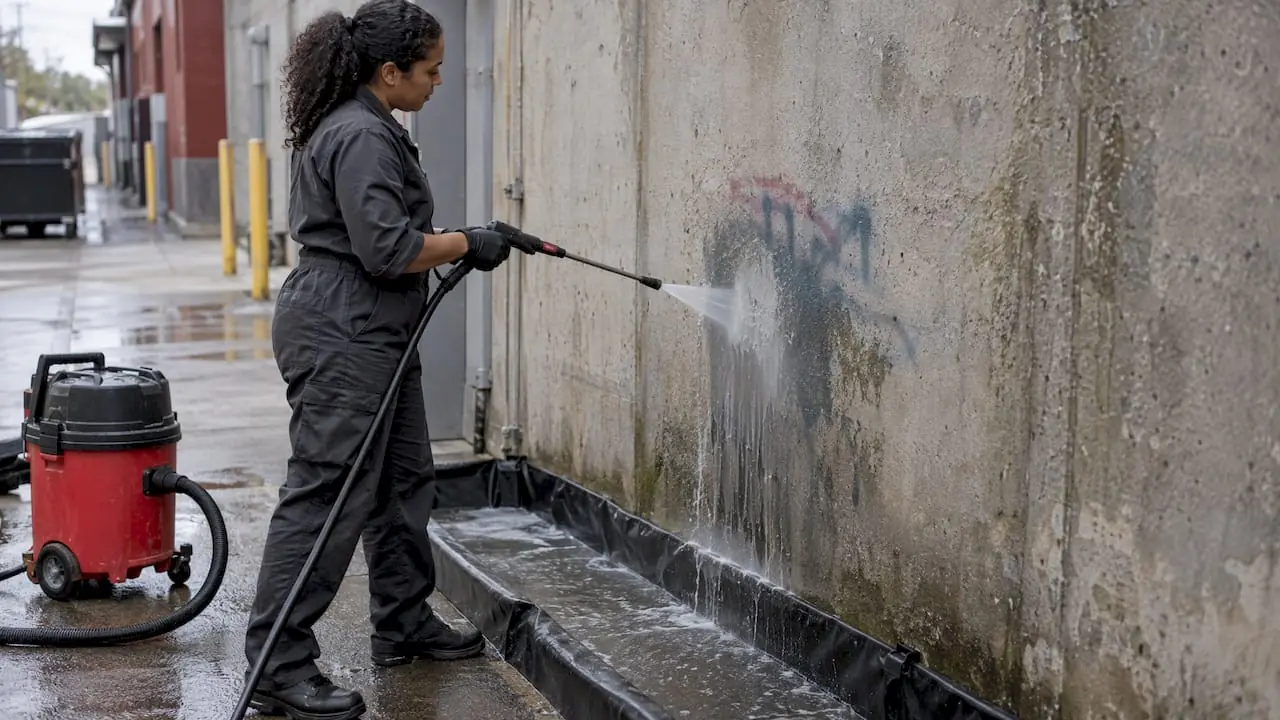
Start with the gentlest method that works: a test patch, then clean water, a plastic or fiber-bristle brush and detergent, then a gel or paste remover made for graffiti. Move to pressure washing or specialty blasting only if those fail, and keep pressure low. Most damage to concrete comes from going too aggressive too soon. The same goes for wire brushes, grinders and sanders. This guide covers the methods in order, the safety rules for chemical removers, how to handle the wash water, and when a property manager or HOA board should hand the job to a professional.
TL;DR
-
Test every method on a hidden spot first. Concrete is porous, and the wrong approach can etch it or leave a permanent stain.
-
Begin with water, a soft brush and clear dish detergent. Then try a gel or paste remover. Keep pressure washing to a last resort and keep it low.
-
Never use wire brushes, grinders or sanders. Wear goggles and gloves with any solvent, and work outdoors, away from ignition sources.
-
Contain and collect wash water. Do not let it reach a storm drain.
-
For large walls, loading docks, parking structures or historic concrete, professional methods such as dry ice blasting avoid water and chemicals.
Table of Contents
Know what you are removing and what it is on
Before you buy a product, work out two things: the type of graffiti and the condition of the surface. The U.S. General Services Administration treats test patches as a required first step. The reason is that the substrate, earlier treatments, paint type and surface condition decide which cleaning method is safe.
Look at these things:
-
Paint type. Spray paint, latex, permanent marker, paint pen and etching cream all behave differently. Marker often sits in the surface. Spray paint sits on top and in pores.
-
Surface texture. Smooth troweled concrete releases paint far more easily than broom-finished, exposed-aggregate or block surfaces.
-
Age of the paint. Fresh graffiti is easier to remove. Paint that has cured for months or years has had time to bond into pores.
-
Surface condition. Cracked, spalled or soft concrete can lose its face under brushing or pressure.
-
Previous sealers or coatings. A sealed wall may clean easily. A wall coated in paint will lose that coating too.
Porous masonry can keep a faint shadow of the design even after the paint is gone. The National Park Service calls this ghosting. It says graffiti removal should begin with the gentlest effective method, after testing in an inconspicuous area. Expect some ghosting on rough concrete and decide up front what result is acceptable.
The step-by-step method, gentlest first
-
Set up a test area. Pick a hidden corner of the same surface. Run each method there and let it dry fully before judging, because wet concrete looks different from dry.
-
Brush with water and detergent. Massachusetts preservation guidance recommends clean water and a plastic or fiber-bristle brush first. If needed, add low-pressure spray at 100 psi or below and clear dishwashing detergent. It says to avoid wire brushes, sanders and power blasting, and to rinse thoroughly twice.
-
Try hot water if cold fails. Hot water may outperform cold water. Water-based gel or paste removers that stay in contact with the graffiti and resist soaking into the concrete.
-
Move to a gel or paste graffiti remover. The NPS recommends a gel or thickened proprietary product that sticks to the surface. Thickened products keep the chemical on the paint instead of letting it run into the concrete.
-
Dwell, agitate lightly, lift. Let the product sit for the time you established on your test patch. The GSA says it must not dry on the surface. It recommends lifting residue with a squeegee, plastic scraper or wet vacuum.
-
Rinse well. The GSA calls for thorough clean-water rinsing and, where the product requires it, neutralizing until the surface tests neutral.
-
Reassess when dry. If a shadow remains, repeat the gentlest step that worked rather than escalating.
Which product for which graffiti
| Situation | Start with | Escalate to | Watch for |
|---|---|---|---|
| Fresh spray paint on smooth concrete | Water, detergent, soft brush | Gel or paste graffiti remover | Residue left in pores |
| Cured spray paint on rough concrete | Gel remover with dwell time | Professional low-pressure washing or blasting | Ghosting, surface wear |
| Fresh permanent marker | Solvent applied as a gel or poultice | Gel graffiti remover | Fumes, solvent soaking in |
| Large walls, structures, historic concrete | Test patch, then professional assessment | Dry ice blasting or micro-abrasion by a pro | Pressure damage to soft surfaces |
Does rubbing alcohol remove graffiti?
Sometimes, on fresh permanent marker. The NPS says fresh marker can respond to acetone, rubbing alcohol or mineral spirits. It adds that solvent systems should be applied as a gel or poultice to control penetration. Wiping liquid solvent onto porous concrete can drive the ink deeper, so thicken it or use a purpose-made gel.
Will vinegar remove spray paint from concrete?
People try it on fresh stains, but it is a gamble. Vinegar is a mild household acid and concrete is sensitive to acids, so test a hidden spot, keep the contact short and rinse thoroughly. For anything more than a small fresh mark, a gel remover made for graffiti gives you more control.
Baking soda and other household fixes
A baking soda paste with a soft brush is gentle and worth a try on a small, fresh mark. It will not break down cured spray paint on textured concrete. Do not spend an afternoon on it for a large area.
Pressure washing: the numbers that matter
Pressure is where most DIY jobs go wrong. The NPS says pressure washing, micro-abrasion and dry-ice misting can all remove graffiti, but should be done by professionals. For washing, its maintenance guidance recommends:
-
Low-pressure spray of 100 to 400 psi.
-
The wand at least 12 inches from the surface.
-
A test first, because soft masonry can be damaged even at low pressure.
-
No grinders, ever.
The GSA specifies water-and-detergent cleaning at 100 to 400 psi or less and 3 to 6 gallons per minute for suitable masonry. Soft masonry gets no more than 100 psi. It also points out that pressure-washing equipment commonly runs above recommended masonry pressures, so a regulator may be needed. The operator should use the lowest pressure that gets the job done and check the surface for damage.
A typical rental washer runs well above that range. Without a regulator or the right nozzle, you can strip the cement paste, expose aggregate and leave a clean-looking scar that is worse than the graffiti.
Handle chemicals and wash water like a regulated job
For a property manager or HOA board, the wash water is the part that creates liability. Treat it as a contained process.
Protect people. The NPS warns that solvents can produce harmful fumes or VOCs, alkaline cleaners can irritate skin and cause chemical burns, and steam can cause heat burns. Appropriate protective equipment is required for each.
If you use an alkaline remover on masonry, NPS guidance says to wet the surface first, rinse from the bottom upward and use a neutralizer afterward to stop continuing damage.
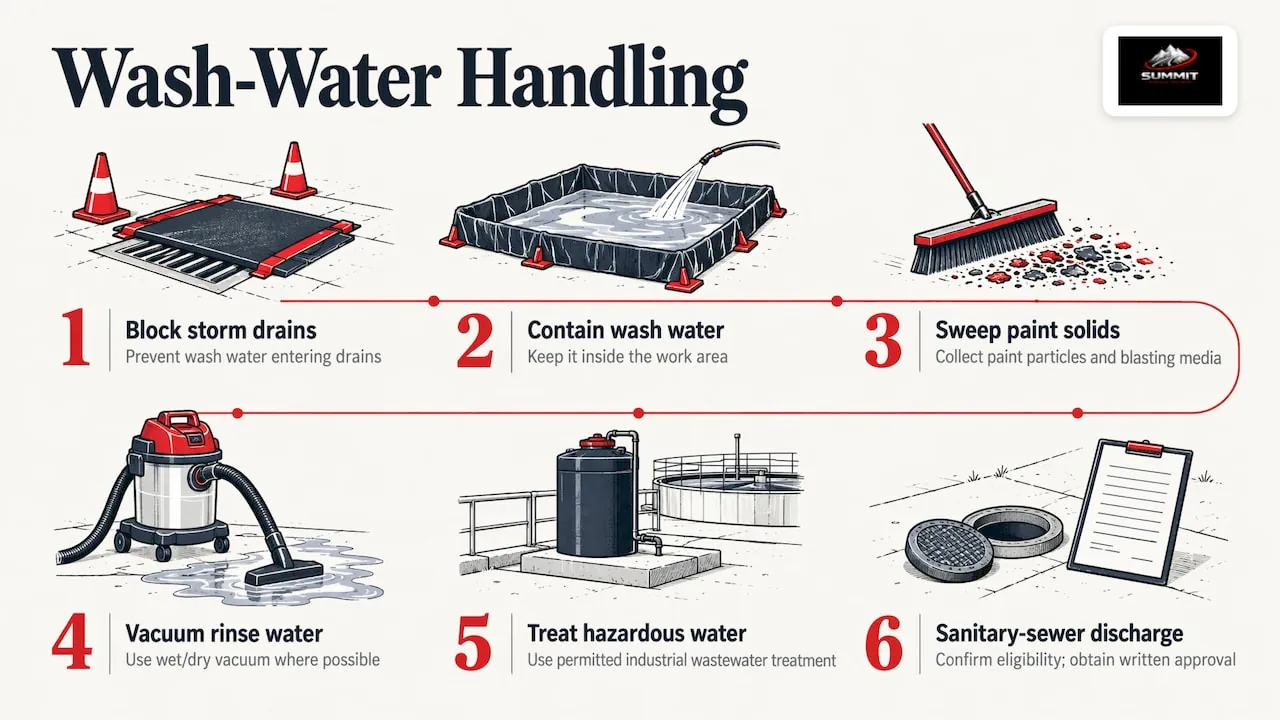
Keep water out of storm drains. Portland’s municipal guidance says to block storm drains, keep wash water inside the work area, sweep up paint particles and blasting media, and collect wash water with a wet/dry vacuum where possible. It also says wash water containing hazardous chemicals or solvents must go to a permitted industrial wastewater treatment facility. Detergent-only water with some paint residue may be eligible for sanitary-sewer discharge only after contacting the relevant authority.
Know what is in the paint. UNC’s power washing guidelines say to contain and screen wash water and to check that its pH is 6 to 10 before sanitary-sewer disposal. They also say to contact EHS to determine the paint’s lead content. Old painted surfaces are worth a lead check before you blast or wash them.
Expect written approval for discharge. The University of Texas exterior washing standards say chemical or detergent washing discharges must not enter storm sewers. Rinsate should be collected and either containerized for hazardous disposal or sent to a sanitary sewer only with written approval.
These are examples from specific institutions and cities. Rules differ by municipality, so in Montana, Idaho or Washington confirm local stormwater and sewer requirements with your city or county before you wash anything down a lot or curb.
Dry ice blasting: a dry option for the hard cases
When the surface is large, textured, historic or near water-sensitive equipment, water and chemicals become the problem. Dry ice blasting propels solid carbon dioxide pellets at the surface. The pellets turn to gas on impact, so there is no wet runoff to collect and no blasting media to sweep up. The NPS lists dry-ice misting among the methods it says professionals should perform, which is the right way to frame it: this is crew work, not a rental-counter job.
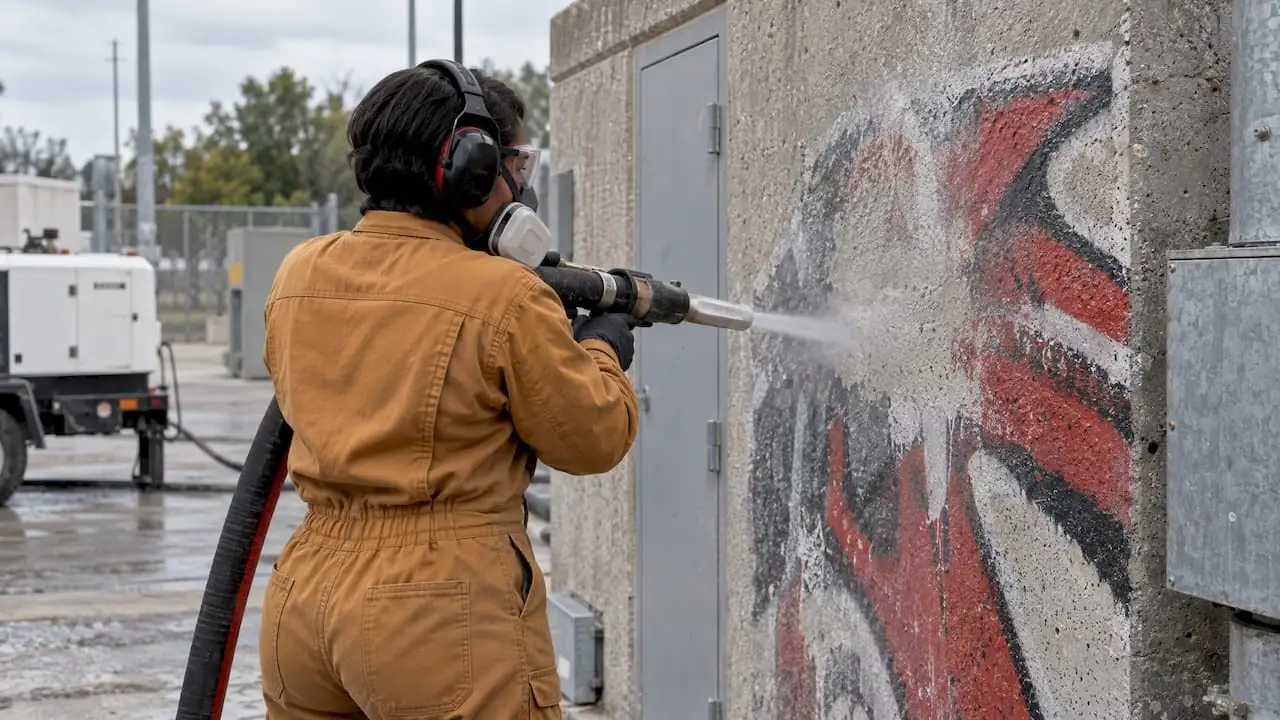
For dry ice blasting, see our sister operation, Summit Cryo. If you are weighing it against water-based cleaning in general, our comparison of dry ice blasting vs. pressure washing walks through where each fits.
What to ask any contractor, ours included, before work starts:
-
What is the surface, and what has been tested on it?
-
What pressure, nozzle and pellet or media settings are planned?
-
How will residue and any water be contained and disposed of?
-
What result should you expect on rough or porous concrete, given the ghosting risk?
Perspective
Graffiti on concrete is usually a surface-condition question before it is a cleaning question. We see the same pattern on pavement: the work that holds up is the work that starts with an assessment, not a product. A test patch, a clear scope and a written plan for water and residue keep a one-day cleanup from becoming a repair bill.
At Summit Surface Partners, our approach is season-aware planning. In Montana, that matters. Cold nights, freeze-thaw cycles and short working windows change what can be cleaned, coated or striped, and when. We prefer to document the surface, agree on the method and put it in a bid-ready scope that a property manager, HOA board or procurement officer can approve without guessing.
For graffiti on large or sensitive concrete, we point customers to dry ice blasting through Summit Cryo, because it avoids the runoff question altogether. For the surrounding lot, drive lanes and curbs, we handle the pavement side: sealcoating, crack sealing, striping and repair. One assessment can cover both.
Summit Surface Partners Team
After the graffiti is gone
Once the paint is off, the area often looks different from the concrete around it. A cleaned patch can read lighter than weathered surroundings. Cleaning the whole panel or wall face to a natural break, such as a joint or edge, makes the difference far less visible than cleaning a tag-shaped patch.
Then reduce the odds of a repeat:
-
Light and visibility. Well-lit walls and clear sightlines draw less tagging than dark corners.
-
Fast response. Fresh paint is easier to remove, so a standing plan for quick cleanup saves effort.
-
Protective coatings. A sacrificial or anti-graffiti coating can make later removal easier on some surfaces. Ask a contractor which type suits your concrete before applying one.
-
Keep the lot in shape. Faded striping, open cracks and neglected pavement signal a property nobody is watching. Our guide on commercial pavement management lays out how to plan upkeep across a portfolio.
Where Summit Surface fits
We serve commercial property managers, HOAs, contractors and public sector buyers across Montana, Idaho and Washington. Our services cover the pavement around the concrete you are cleaning: parking lot maintenance, sealcoating, crack sealing, striping and ADA layouts, resurfacing, repair and seasonal snow and ice. We also produce our own sealcoat locally and supply it wholesale to contractors.
If graffiti cleanup is part of a larger lot or property project, ask us to fold it into one assessment and one bid-ready scope. Dry ice blasting runs through Summit Cryo. You can reach our team through our main site.

If you manage several properties, a single assessment visit can cover concrete cleaning needs, pavement condition and striping in one pass.
FAQ
What is the safest way to remove graffiti from concrete?
Test a hidden spot, then start with clean water, a plastic or fiber-bristle brush and clear dish detergent at low pressure (100 psi or below). If paint remains, use a gel or paste graffiti remover and rinse twice. Avoid wire brushes, grinders, sanders and high-pressure blasting, which can scar the surface.
Can I pressure wash graffiti off concrete myself?
You can, but pressure is the main way people damage concrete. Federal preservation guidance recommends 100 to 400 psi, a wand at least 12 inches from the surface and a test first. Soft or cracked concrete can be damaged even at low pressure. You also have to contain and collect the wash water instead of letting it reach a storm drain.
Why can I still see the graffiti after the paint is gone?
That faint shadow is called ghosting. Porous or rough concrete holds pigment in its pores, and even a good cleaning may not lift it all. Cleaning the whole panel to a joint or edge makes the result look more even. A professional can judge whether a further step is worth the risk to the surface.
When should a property manager hire a professional?
Call a professional when the area is large, the concrete is textured, soft or historic, the paint may contain lead, or you cannot contain the wash water. Dry ice blasting through Summit Cryo is an option when you want to avoid water and chemical runoff. Call or email us for a free estimate, and we will assess the surface, the pavement around it and the best sequence of work."]